
The Production Advantage of Using a GNSS Rover for Civil Construction Layout (vs. Tapes, Offsets, and Stakes)
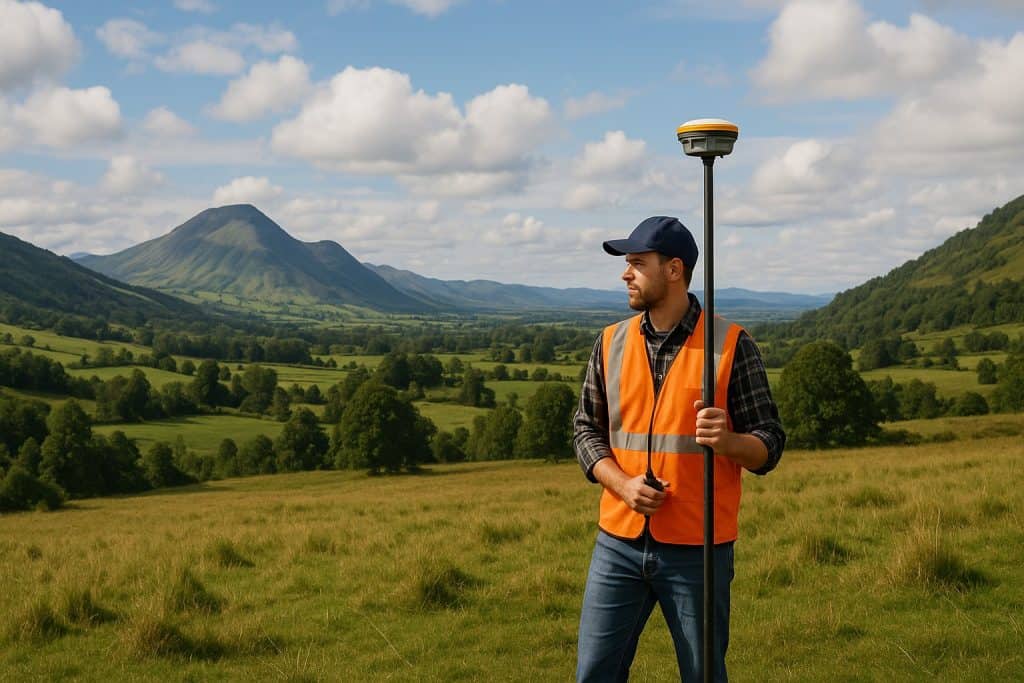
Civil construction is a production game. If your layout is slow, inconsistent, or hard to verify, the whole job suffers—equipment sits, crews wait, rework shows up late, and nobody feels good about the schedule. That’s where a GNSS rover earns its keep: it turns layout from a “craft-only” process into a faster, more repeatable workflow with built-in checks.
Below is a practical, field-focused breakdown of why GNSS rover layout typically outproduces old-school methods like pulling tapes, offsets, batteries, nails, hubs, and endless stakes.
1) Faster “point to ground” layout (less setup, fewer steps)
Traditional layout often looks like this:
- Find control (or create it)
- Establish a baseline/stringline
- Pull tape measures, set offsets
- Check diagonals
- Set hubs/stakes
- Mark, paint, tag
- Recheck because something shifted or the tape pulled wrong
GNSS rover layout compresses that workflow:
- Initialize rover and verify localization/site calibration
- Select point/line/feature from design
- Walk to position and stake/mark it
- Verify instantly
Why this matters:
Every step you remove is production gained. A GNSS rover cuts out a lot of the “support work” (pulling, holding, resetting, re-measuring) that eats time and requires multiple people.
Typical production boost: A two-person tape crew can often become a one-person rover layout workflow for many tasks—especially rough and medium-precision layout.
2) Fewer people tied up in layout (labor efficiency)
Old-school layout is manpower-hungry. Pulling tapes and offsets is frequently at least two people, sometimes three when conditions are ugly (traffic, slopes, long pulls, wind, mud, obstacles).
With a rover, a single field tech can:
- Lay out points continuously
- Verify as they go
- Keep the work moving without needing a second person on the end of a tape
Why this matters:
Saving even one person for half a day, repeatedly, adds up fast. That extra person can be:
- Running grade
- Setting pipe
- Loading trucks
- Running compaction
- Building forms
- Doing fine grading
In other words: layout stops being a bottleneck.
3) Instant verification = less rework and less “layout anxiety”
One of the biggest hidden costs in civil work is uncertainty:
- “Is that stake right?”
- “Did we pull the right offset?”
- “Are we measuring from the correct control point?”
- “Did the tape sag?”
- “Did we read the wrong station?”
- “Is this the same baseline from yesterday?”
A GNSS rover gives you the ability to:
- Check any point at any time
- Confirm a feature is where you think it is
- Verify distances and alignment without re-running tape pulls
Why this matters:
Verification is production. If the crew trusts layout, they build faster. If they don’t trust it, they slow down, second-guess, and re-check everything.
4) Better performance on long distances and big sites
Tapes and offsets work fine in tight footprints. But civil jobs are rarely small and clean:
- Long centerlines
- Large pads
- Big corridors
- Utility runs
- Miles of curb
- Large detention systems
- Sprawling subdivisions
Traditional methods struggle because long pulls introduce:
- Tape sag and stretching
- Accumulated error
- More intermediate points and transfers
- Higher chance of compounding mistakes
With GNSS:
- Long distances are not inherently harder
- You’re always working relative to the coordinate system and control
- The rover doesn’t “get tired” after 600 feet of offsets
5) More layout in less time (and easier to keep pace with equipment)
On civil sites, equipment production is often high:
- Excavators can dig fast
- Dozers can move volume quick
- Crews can install pipe rapidly when trench is ready
But equipment can also get strangled by layout delays:
- Waiting for line and grade
- Waiting for structures to be pinned
- Waiting for curb radii points
- Waiting for slope stakes
- Waiting for as-builts or verification checks
A rover helps you stay ahead of the iron:
- Layout points as the crew approaches them
- Re-check after disturbance
- Update the plan in the controller (if you’re running modern workflows)
This is how GNSS translates into real dollars: equipment time is expensive—and the rover helps you keep it moving.
6) Cleaner communication: stations, offsets, and “tribal knowledge” become coordinates
Old school layout depends heavily on:
- Handwritten stakes
- “Start from that hub”
- “Offset 10 left from the centerline”
- “Use the nail we set yesterday”
- Field interpretation
That works… until:
- The wrong stake gets pulled
- Someone misreads the cut/fill
- A different crew comes in
- It rains and paint disappears
- The job gets complicated
GNSS layout is less dependent on “tribal knowledge” because:
- The point is stored and defined in the data collector
- The workflow is repeatable
- You can label features consistently
- You can stake from design directly
Less interpretation = fewer mistakes.
7) Better consistency across crews and across time
One of the underrated advantages is consistency:
- Different foremen measure slightly differently
- Different laborers pull better or worse tapes
- Baselines drift
- Stakes get destroyed and re-set
A rover provides a consistent method:
- The same point staked today can be checked tomorrow
- A new crew can verify without relying on “that one guy who remembers”
- Layout becomes scalable
This matters on jobs that run weeks or months, or where crews rotate.
8) Faster troubleshooting when something doesn’t fit
When pipe doesn’t hit a structure, curb returns don’t close, or grades don’t match, traditional troubleshooting can be slow:
- Re-run baselines
- Re-check offsets
- Re-pull diagonals
- Hunt for the original stake
- Argue about which reference is correct
With a rover, you can quickly:
- Check key control points
- Verify what was built vs. design locations
- Confirm line and alignment
- Identify where the drift started
This reduces downtime and helps you make decisions faster—especially when you’re burning daylight.
9) Safer and less physically demanding layout
Production isn’t just speed—it’s sustainable speed.
Traditional layout can be rough:
- Long tape pulls near equipment
- People walking backward while holding tapes
- More time in travel lanes
- More exposure to hazards
A rover can reduce:
- The time people spend near moving equipment
- The number of people needed on the ground doing risky tasks
- The physical strain of repeated long pulls and resets
Safer work tends to be faster work long-term—less fatigue, fewer mistakes, fewer incidents.
10) A realistic note on limitations (and how to still win)
GNSS isn’t magic. The real production advantage comes when you use it correctly.
Situations where you need to be smart:
- Tree canopy, buildings, narrow cuts (signal multipath / poor sky view)
- Tight tolerance work (some tasks may require total station)
- Bad or unverified control (garbage in, garbage out)
- Rushing site calibration/localization
But even with these limitations, a rover still dominates old school methods for most civil layout tasks, especially:
- Rough grading checks
- Subgrade/finish grade spot checks (where appropriate)
- Utility trench alignment points
- Structure staking
- Roadway points (centerline, edge of pavement points)
- Detention pond features
- Pad corners and offsets
The best production teams use GNSS for 80–90% of layout and bring in a total station for the remaining tight-tolerance tasks.
Practical examples of “production wins” you feel immediately
Here’s what crews usually notice right away:
- You can lay out more points per hour
- You can work solo for many tasks
- You spend less time re-checking
- You have confidence in line and position
- You reduce rework
- Equipment waits less
- Foremen argue less about “whose tape was right”
That’s the real advantage: flow. When layout is fast and verifiable, the whole job starts to run smoother.
Bottom line
Using a GNSS rover for layout is a shift from measuring-and-hoping to measuring-and-knowing. It reduces steps, reduces labor, increases repeatability, speeds verification, and keeps crews and equipment moving. In civil construction—where margins depend on production—those gains stack up quickly.